

Guy Glantser read my 2009 post on how I use GTD’s 50,000 foot goals, and commented:
Hi Brent,
It’s been 8 years since you wrote this post, and it’s still very inspirational today. Thank you for that!
I wonder if you are still using the same methods today. If not, how have you evolved the GTD process over the years?
I would love to read a followup post, or at least a short update.Thanks!
Great question! Here’s how I use GTD, RTM, retreats, and the Epic Life Quest to manage my life.
The book Getting Things Done tells you to come up with a set of 50,000 foot goals, things that will drive how you live your life. After years of tweaking, they’ve boiled down to:
- Retire with complete financial security.
- Be a fantastic partner for my loved ones.
- Enjoy my time on Earth as many ways as I can.
These all have to be in harmony with each other. Obviously, if you focus too much on any one of them, you’re going to do a disservice to the others. (I’d love to hang out with my family all day every day, but then we’ll be broke in a year, and I won’t be such a good partner then.)

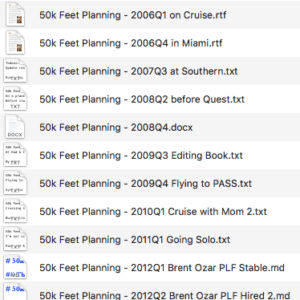
With GTD, you’re supposed to build out a series of goals underneath those – for example, under #3, I have goals for being healthy, bringing joy to strangers, etc. Then, whenever you have a new task in your to-do list, you need to make sure it actually maps up through your goals – otherwise, it’s probably not something you should bother doing.
When I first started doing this a decade ago, I had a lot of realizations. I didn’t know what I really wanted out of my life, and my day-to-day tasks didn’t match up with what was really important to me. I was doing a lot of busy work, treading water in my career, not making significant progress.
In GTD, David Allen tells you to do an annual review to keep revisiting your goals and your tasks. I do this during my retreats, and it’s a really valuable process. Every time I do it, I read through my older notes first to celebrate how the process has worked for me and made me a better person.
It also helps me feel much more comfortable when I make major decisions like taking a break from teaching in-person classes: instead of feeling guilty about leaving money on the table, I’m able to realize that making this compromise on my retirement goals means that I can be a better partner and enjoy my time more. (It already paid off, too – I had a sudden opportunity to add a family commitment in 2018 that I wouldn’t have been able to do if I was traveling to teach.)
So in summary, I use:
- Getting Things Done techniques to build my strategic goals
- RememberTheMilk to track the tactical tasks I need to perform to meet those goals
- Annual retreats to refine my goals and make sure the wrong tasks didn’t sneak in (next up: heading to Cabo on Saturday for a week of reflection & relaxation)
- My Epic Life Quest to track and share the things I’m proud of achieving